




 Get Started
How Do I Maintain A Large Roof In Chapel Hill, NC? (8 Tips)
07.21.2026
12 Min Read
A large roof means more square footage, more valleys, more flashing, more gutters, and more surface area where small problems can develop and go unnoticed. If you own a home in Chapel Hill with a significant roof footprint, proactive maintenance is not optional, it is what separates a roof that performs for 40 years from one that starts causing expensive problems within 15. Understanding how to maintain a large roof in Chapel Hill, NC gives you a clear, seasonal framework for protecting one of your home’s most critical systems. Chapel Hill’s humid climate, heavy tree canopy, and active storm seasons make that framework more important than it would be in a drier or less wooded environment. Keeping up with maintenance consistently is the single most cost-effective thing you can do for a large roof.
Here is what this guide covers:
- Why large roofs in Chapel Hill require a different maintenance approach than smaller ones
- Eight specific, actionable maintenance tips tailored to Chapel Hill’s conditions
- A seasonal maintenance schedule to follow throughout the year
- What warning signs to watch between professional visits
- When to call a professional and when ground-level observation is enough
What Makes a Large Roof in Orange County, NC Different to Maintain
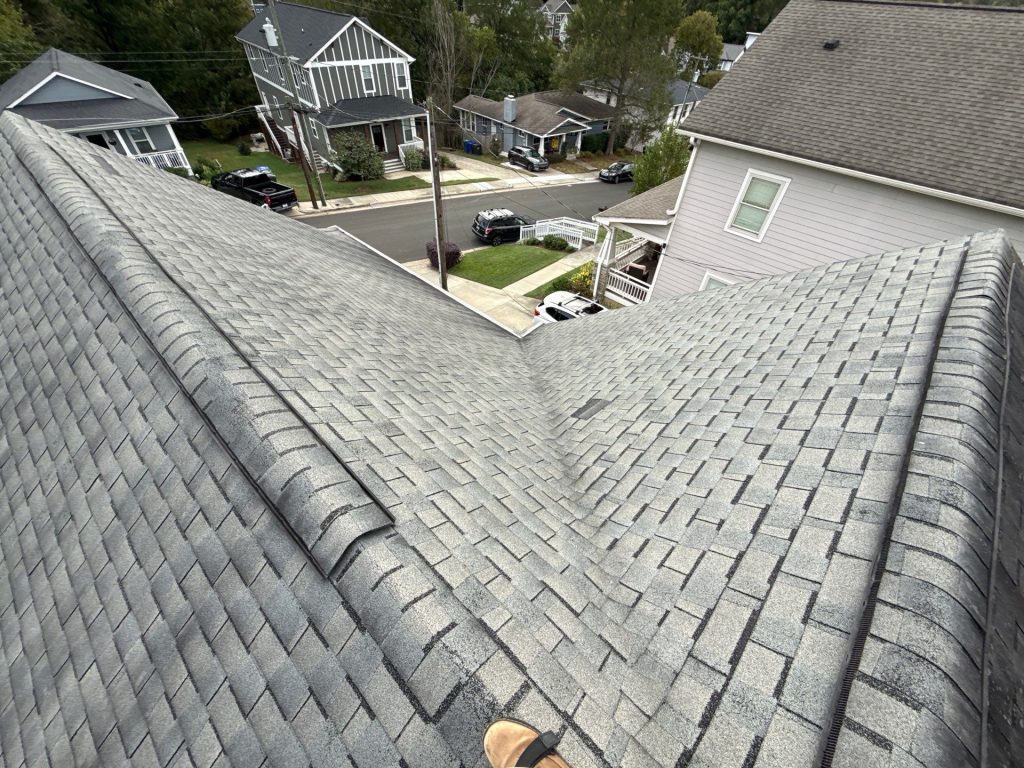
Size is not the only factor that changes the maintenance equation, but it changes it significantly. A larger roof has more valleys where water concentrates during rain, more linear feet of flashing around penetrations and transitions, more gutters that have to function properly for drainage to work, and more total surface area where algae, moss, and debris can establish themselves. Missing a problem in one section of a small roof might affect a limited area. On a large roof, the same problem left unaddressed can cause damage across a much broader zone before it becomes noticeable.
Homeowners are deferring critical home maintenance, representing nearly 59 million homes with unaddressed vulnerabilities, and roof damage accounts for up to 90% of residential catastrophe losses. For Chapel Hill homeowners with large roofs in an active storm corridor, that combination of deferred maintenance and storm exposure is a meaningful risk.
A consistent maintenance approach on a large Chapel Hill roof delivers:
- Extended material lifespan: Shingles that are kept clean, properly ventilated from below, and free of debris accumulation consistently outlast neglected ones by years or decades
- Earlier problem detection: Regular inspection of a large roof surfaces issues at the repair stage rather than the replacement stage, when costs are a fraction of what full remediation would run
- Storm performance: A roof that has been consistently maintained is simply better equipped to handle hail, wind, and heavy rain than one with accumulated deferred maintenance
- Insurance and warranty compliance: Many manufacturer warranties require documented maintenance to remain valid; consistent upkeep protects the coverage you paid for
- Lower lifetime cost: Proactive maintenance on a large roof costs far less over time than reactive repairs driven by water intrusion and the collateral damage it causes
8 Roof Maintenance Tips for Large Roofs in Chapel Hill, NC
These tips apply to any residential roof, but each one carries additional weight when the roof is large, complex, or sitting under the kind of tree coverage common in Chapel Hill’s established neighborhoods.
1. Commit to Twice-Yearly Professional Inspections
On a large roof, the gap between a visible problem from the ground and an active leak inside the home can be significant. A professional inspector walking the full surface will find things that are simply not detectable from the driveway: lifted shingles in areas not visible from below, compromised flashing around a dormer, soft spots indicating moisture in the decking, and early granule loss that signals a section approaching the end of its service life.
Schedule professional inspections in spring after winter freeze-thaw cycles and in fall before the wet season. Add an inspection after any storm that produces significant hail or wind. On a large roof, the cost of a professional inspection is minimal compared to the value of finding a problem before it causes water damage to the structure below.
- Spring: assess shingle condition after freeze-thaw, check all flashing, verify ventilation is functioning
- Fall: clear debris, check gutter attachment, inspect valleys before heavy rain season begins
- Post-storm: targeted assessment of any area that may have taken hail or wind-driven debris impact
2. Keep All Valleys and Low Points Clear of Debris
Valleys are the low points where two roof planes meet, and on a large roof with a complex roofline there may be several of them. Because water volume concentrates in valleys during rain events, they are among the most critical areas to keep clear at all times.
Pine needles, leaves, and small branches that collect in valleys do not simply wash away during rain. They compact, dam water flow, and hold moisture against the roofing materials underneath them. In Chapel Hill, where pine needle accumulation from nearby mature trees can be substantial, keeping valleys clear is a regular seasonal task rather than an annual one. After any significant leaf fall or storm debris event, clearing the valleys should be a priority.
3. Maintain Gutters and Downspouts on a Consistent Schedule
On a large roof, the volume of water that moves through the gutter system during a Chapel Hill thunderstorm is substantial. Gutters that are clogged, pulling away from the fascia, or improperly sloped do not just fail to drain — they push water back against the roofline, cause rot in the fascia boards behind them, and can contribute to moisture infiltration at the eave.
Clean gutters at minimum twice per year — after fall leaf drop and again in spring. On large roofs with significant tree coverage, quarterly cleaning is more realistic. At each cleaning, inspect the gutter hangers and downspout connections, check that the slope is still directing water toward the downspouts, and look for granule accumulation in the gutter channel, which is one of the most reliable indicators of how much wear your shingles have experienced recently.
- Check that downspouts are clear and directing water at least four feet from the foundation
- Look for sections pulling away from the fascia that indicate wood rot may be developing behind them
- Consider gutter protection systems to reduce debris accumulation on roofs with heavy tree coverage
4. Trim Tree Coverage Over and Around the Roof
Chapel Hill’s mature tree canopy is one of the things that makes the town’s residential neighborhoods distinctive and desirable. It also creates ongoing maintenance demands for large roofs. Branches that overhang the roof deliver a continuous stream of debris, keep the surface shaded and damp longer after rain, and create a pathway for squirrels and other animals to access the roof and potentially find their way into the attic.
The practical standard is to keep branches trimmed back at least six feet from the roof surface. On the north-facing portions of a large roof, which receive less sunlight and dry out more slowly after rain, maintaining that clearance is especially important because sustained moisture is the primary driver of algae and moss growth.
5. Monitor and Address Algae, Moss, and Lichen Growth
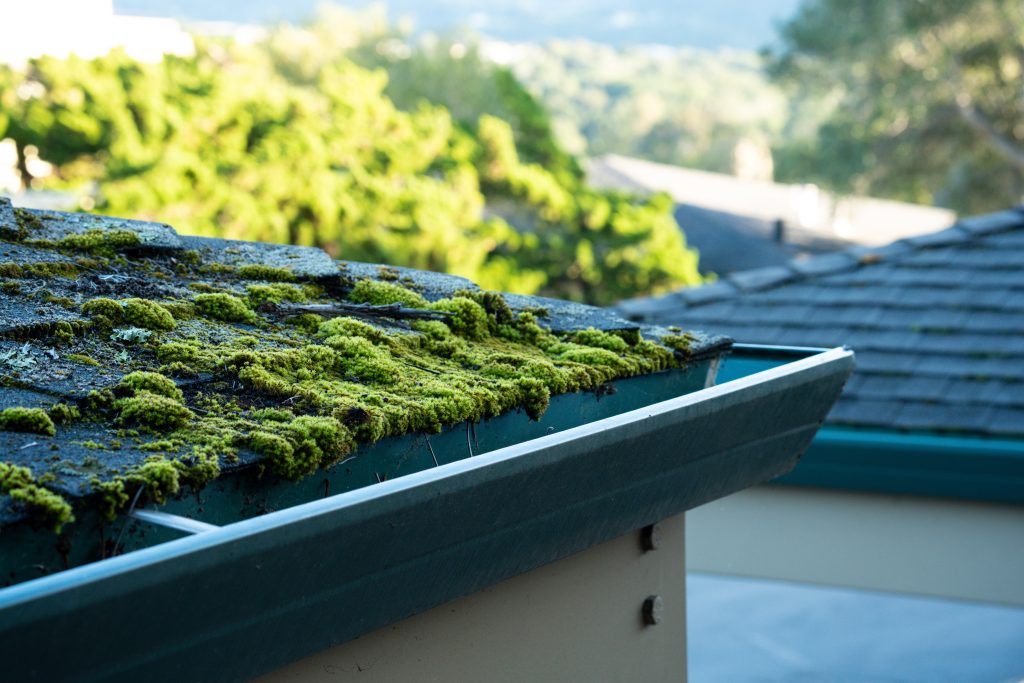
The dark streaking that appears on many Chapel Hill roofs within a few years of installation is algae — specifically Gloeocapsa magma, which thrives in the humid conditions the Triangle provides consistently. On a large roof, algae that gets a foothold in one section tends to spread across adjacent sections if left untreated.
Moss presents a more serious problem. Unlike algae, which stains the surface, moss physically roots into the shingle granules and retains moisture against the shingle surface beneath it. Over time, this accelerates granule loss and can cause shingles to lift and curl. Lichen is the most aggressive of the three and the hardest to remove once established.
Approaches for Chapel Hill homeowners include:
- Zinc or copper ridge strips: Release trace metals during rain that inhibit growth across the roof surface below without requiring active treatment
- Soft washing: A low-pressure application of a diluted cleaning solution by a professional is the correct approach for active growth — never high-pressure washing, which damages granules
- Algae-resistant shingles: Products with algaecide-infused granules are worth specifying on any future replacement for a Chapel Hill home
6. Inspect Flashing at Every Penetration and Transition
Flashing is the metal material that seals every point where the roof surface meets a vertical surface or transitions between planes: Chimneys, skylights, dormers, vent pipes, and all roof valleys. It is the single most common source of roof leaks on residential homes in the Triangle, and on a large roof with multiple penetrations and complex transitions, there is simply more of it to monitor.
At each professional inspection, every flashing joint should be checked for separation, corrosion, or sealant that has dried and cracked. Flashing around chimneys is particularly prone to failure because the temperature differential between the masonry and the roofing materials causes repeated expansion and contraction. Catching a failing flashing joint at the resealing stage is a minor repair; catching it after water has been infiltrating for a full season is a significantly larger project.
7. Verify Attic Ventilation Is Performing
Proper attic ventilation is one of the most under-maintained components of a large roof system. In Chapel Hill’s climate, adequate ventilation is important for two distinct reasons: it prevents heat buildup that accelerates shingle degradation from below during hot summers, and it prevents moisture accumulation that creates conditions for mold growth and wood rot in the decking and framing during the humid months.
Signs of ventilation problems on a large roof include shingles that are curling or aging faster than expected, unusually high cooling costs during summer months, and visible moisture staining or mold in the attic space. A professional inspection should always include verification that ridge vents and soffit vents are working together to create adequate passive airflow for the attic square footage they serve.
8. Keep Detailed Maintenance Records
Maintenance records serve several practical purposes for a Chapel Hill homeowner with a large roof. They support warranty claims if a material defect arises, provide documentation for insurance purposes if a storm damage claim becomes necessary, give contractors useful context when assessing future repairs, and help track whether any area of the roof is showing recurring or progressively worsening issues.
A simple log noting the date of each inspection, what was found, what was repaired, and by whom is sufficient. Photographs of any areas of concern are particularly useful because they allow you to compare conditions across inspection cycles and identify trends before they become failures.
A Seasonal Roof Inspections Calendar for Chapel Hill, NC Homeowners
Organizing maintenance tasks by season makes a large roof manageable. Here is a practical framework:
Spring (March to May) Clear winter debris from all valleys and low points. Schedule a professional inspection to assess any damage from freeze-thaw cycles. Clean gutters after spring pollen and seed pod drop. Trim any branches that have grown into the six-foot clearance zone over winter.
Summer (June to August) Monitor the roof after each significant thunderstorm for visible shingle damage or displaced materials. Check gutters mid-summer if tree coverage is heavy. Verify that attic ventilation is performing by checking attic temperature on hot days — an excessively hot attic in summer is a ventilation signal worth acting on.
Fall (September to November) This is the most important maintenance window of the year for Chapel Hill homeowners. Clear valleys and gutters after the full leaf drop. Schedule a professional fall inspection before the wet season begins. Assess any areas where algae or moss established during the humid summer months.
Winter (December to February) Check the attic after any significant cold snap for condensation or frost that could indicate ventilation problems. Monitor eaves for ice dam formation during freeze-thaw periods. Note any areas where snow or ice appears to be melting unevenly, uneven melt patterns can indicate heat loss through the decking from below.
When to Call a Pro vs. Taking a Closer Look From the Ground

Some maintenance tasks are appropriate for homeowners to handle without getting on the roof: gutter cleaning from a ladder, ground-level visual inspections with binoculars, trimming lower branches, and clearing debris visible from the edge. Anything that requires walking the roof surface, working near the ridge, or evaluating structural integrity belongs in the hands of a licensed roofing contractor.
This boundary is especially important on large roofs where steep pitches, complex rooflines, and multiple levels make safe access genuinely technical. A professional inspection on a large Chapel Hill roof costs a fraction of what emergency repair costs when a problem is caught late, and it eliminates the injury risk that comes with homeowners attempting roof access on challenging structures.
If storm damage is suspected after a hail or wind event, a professional inspection also matters for insurance documentation purposes. A licensed contractor’s written findings are far more useful to an insurance adjuster than a homeowner’s self-assessment, and the quality of that documentation often determines how smoothly a claim resolves.
Protecting Your Chapel Hill, NC Home With the Right Roofing Materials and Care
How to maintain a large roof in Chapel Hill, NC comes down to a consistent, seasonal approach that keeps small problems from becoming large ones. A large roof that is inspected professionally twice per year, kept clear of debris, has functioning drainage and ventilation, and has its flashing monitored regularly will consistently outperform one that receives attention only after something fails.
At Barkley-Jensen Roofing and Restoration, we work with Chapel Hill homeowners on inspections, repairs, and maintenance programs designed for the Triangle’s specific climate demands. We are GAF Certified, licensed, and insured in North Carolina, and we back all repair and replacement work with a 5-year workmanship warranty. If your large roof is overdue for a professional inspection or a recent storm has you concerned about its condition, contact us today and we will take a thorough look and give you honest, specific findings.