




 Get Started
When Should I Replace My Roof In Holly Springs, NC?
09.08.2026
12 Min Read
Knowing the right time to replace a roof is one of the most valuable things a Holly Springs homeowner can figure out before water damage, a failed inspection, or a denied insurance claim forces the decision for them. When to replace a roof in Holly Springs, NC is not always obvious from the ground, and waiting too long is consistently more expensive than replacing at the right time. Holly Springs homes face real pressure from summer thunderstorms, heat and humidity, and the occasional tropical system remnant, all of which accelerate wear on roofing materials. Understanding how professionals evaluate roof condition is the starting point for making that call with confidence rather than guessing.
Here is what this guide covers:
- How long different roofing materials actually last in Holly Springs’ climate
- The clearest signs your roof needs replacement rather than repair
- How Holly Springs’ weather conditions specifically affect roof lifespan
- What the replacement process looks like and what to expect from a quality contractor
- How to budget for a roof replacement and what factors affect the total cost
The Case for Acting Before Your Roof Forces Your Hand

Most homeowners replace their roofs reactively, after a visible leak, after a home inspection during a sale, or after storm damage that makes the existing roof’s condition impossible to ignore. Reactive replacement is consistently more expensive than planned replacement because water infiltration that triggers the decision has usually been progressing for months or longer, causing damage to decking, insulation, and in some cases interior framing that adds significant scope to the project.
According to the International Association of Certified Home Inspectors (InterNACHI), three-tab asphalt shingles typically last 15 to 20 years, while architectural asphalt shingles last 20 to 30 years — though real-world performance in humid, storm-active climates like Holly Springs tends to land toward the lower end of those ranges. For homeowners whose roofs are approaching or past those thresholds, a proactive assessment is a far better starting point than waiting for a symptom to appear.
Knowing when to replace provides:
- Cost control: Planned replacement at the right time avoids the collateral damage costs that come with reactive replacement after a leak has been developing for months
- Insurance positioning: A roof in known good condition at the time of a storm damage event is much easier to insure and claim against than one with pre-existing issues that complicate the claim
- Sale readiness: A replaced or recently inspected roof is one of the most valuable disclosures in a real estate transaction; an aging roof is one of the most common deal complications
- Energy efficiency: Aging roofs with compromised ventilation and degraded insulation below cost more to heat and cool; a replacement done at the right time captures efficiency improvements that reduce monthly operating costs
- Peace of mind: Knowing your roof is sound and under warranty is worth something in its own right for any Holly Springs homeowner who has gone through a storm season without confidence in the structure above
7 Signs It Is Time to Replace Your Holly Springs Roof
No single sign is definitive on its own, but the presence of multiple signals — or any one of the more serious indicators below — is a strong case for professional evaluation and likely replacement. These are the signs that Holly Springs homeowners and roofing professionals look for when assessing whether repair or replacement is the right call.
1. Age Beyond the Shingle’s Realistic Lifespan
The age of a roof is the single most important baseline factor in any replacement decision. A roof that is within its expected lifespan and showing no distress signals may only need maintenance and monitoring. A roof that has exceeded its realistic lifespan is a replacement candidate regardless of whether visible symptoms are present, because the degradation that causes failures is often not visible until the failure itself occurs.
For most Holly Springs homes with architectural asphalt shingles — the most common product installed during the town’s major residential growth periods — the realistic performance window is 22 to 25 years in North Carolina’s climate. Homes built during the late 1990s and early 2000s growth boom are entering or approaching that window in 2026.
- Architectural shingles: realistic lifespan of 22 to 25 years in NC conditions
- 3-tab shingles: realistic lifespan of 15 to 18 years, often less under storm pressure
- Metal roofing: 40 to 70 years depending on gauge and installation quality
- Age alone is sufficient reason for a professional evaluation, even without visible distress
2. Widespread Granule Loss
Granules are the protective coating on asphalt shingles that block UV radiation, provide fire resistance, and give the shingle its weather-resistant surface. Granule loss is part of normal aging, but widespread or accelerating granule loss signals a shingle that is near the end of its functional life.
The easiest place to observe granule loss is in the gutters, where granules wash off during rain events and accumulate in the gutter channel. A large volume of granules in the gutters after rain — particularly without any recent storm damage — indicates the shingles are shedding their protective coating rapidly. Areas of the roof where bare or discolored asphalt patches are visible are showing the same problem from above.
Once granule loss reaches the point where bare asphalt is exposed across significant portions of the roof, repair is not a realistic option. The underlying shingle mat degrades quickly without its granule coating, and the degradation accelerates across the entire affected section.
3. Curling, Cupping, or Clawing Shingles
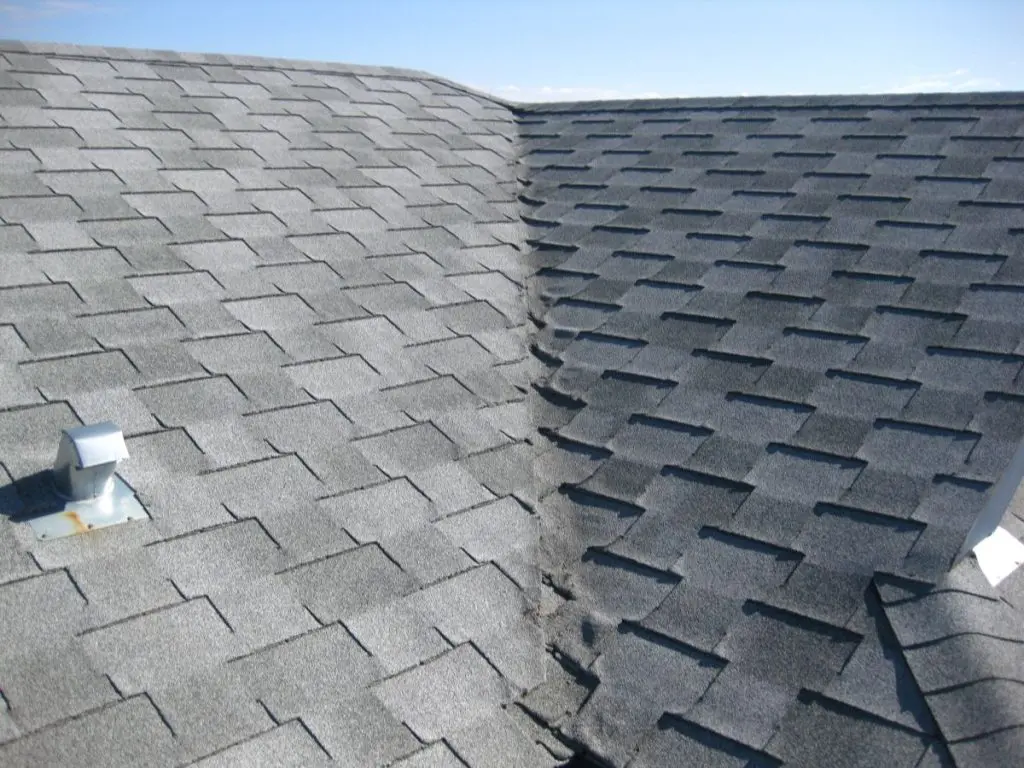
Shingles that curl upward at the edges, cup along the body, or show the clawing pattern where the middle lifts while the edges stay flat are displaying signs of advanced aging and are no longer providing a complete weather barrier.
Curling and cupping develop when the asphalt and fiberglass layers within the shingle break down at different rates, creating tension that deforms the shingle away from the flat profile it needs to shed water correctly. In Holly Springs’ climate, the combination of hot summers with high UV exposure and seasonal temperature variation accelerates this breakdown relative to cooler climates.
Curled or cupped shingles are vulnerable to wind uplift, allow wind-driven rain to get underneath them, and cannot be effectively repaired by coating or adhesive. Widespread curling across the roof surface is a clear replacement indicator.
4. Missing or Cracked Shingles
Missing shingles are the most immediately visible replacement signal from the ground. Any gap in the shingle surface is a direct opening for water infiltration, and on a Holly Springs roof subject to frequent summer thunderstorms, even a single missing shingle warrants prompt professional attention.
Cracked shingles present a more subtle version of the same problem. Thermal stress causes asphalt shingles to expand and contract through seasonal temperature cycles, and over time that cycling cracks the shingle along stress lines. Cracks may not be immediately visible without walking the roof surface, but they allow water to infiltrate the shingle and reach the underlayment and decking below.
When missing or cracked shingles are isolated to one section, repair may be appropriate. When they are distributed across multiple sections of the roof, it typically indicates the entire shingle system has reached a stage of degradation where replacement is more cost-effective than ongoing repair.
5. Interior Water Stains or Active Leaks
Water stains on the ceiling, peeling paint near the roofline, or visible mold growth in the attic are late-stage indicators that water has already been infiltrating the roof assembly. By the time staining is visible inside the home, the moisture has typically traveled through multiple layers — shingles, underlayment, and decking — before reaching the interior surface.
The presence of interior water staining does not automatically mean full replacement is required, but it does mean the situation is urgent and a professional inspection is needed immediately. In many cases, staining that appears in one area of the ceiling correlates to a damaged area of the roof that is far from that location, because water travels horizontally through the roof assembly before finding a path to the interior. A professional inspector can identify the source rather than just the symptom.
6. Sagging Roof Sections
A sagging or visibly deformed roof deck is one of the most serious indicators a Holly Springs homeowner can observe, because it suggests structural damage that goes beyond the shingles themselves. Sagging can result from chronic moisture that has rotted the decking and framing below, from structural overload, or from long-term moisture accumulation that has compressed and degraded the insulation and structural members supporting the roof system.
Any visible sagging warrants immediate professional evaluation. In most cases, sagging indicates that decking and potentially framing replacement is required in addition to a full shingle replacement, which changes the scope and cost of the project significantly. Early identification is important because structural damage that is caught early is substantially less expensive to remediate than damage that has progressed for additional seasons.
7. Failing or Repeated Flashing Issues
Flashing is the metal material that seals every penetration and transition in the roof system — around chimneys, skylights, pipe boots, and in valleys. It is the most common source of roof leaks and one of the first components to fail on an aging roof system.
When flashing fails once, repair is typically the right response. When the same flashing points fail repeatedly, or when multiple flashing locations are failing simultaneously, it often indicates that the underlying roof system has aged to the point where the flashing cannot maintain a seal against the movement and expansion of the degrading shingles and decking around it. Repeated flashing failures on a roof that is already at or past its expected lifespan are a strong signal that a full replacement is the more cost-effective long-term solution.
How Holly Springs’ Climate Affects Roof Lifespan
North Carolina’s climate creates a specific combination of stresses that consistently drives roofs toward the lower end of their rated performance windows. Holly Springs homeowners should factor these local conditions into their replacement planning.
- Heat and UV exposure: Holly Springs summers push temperatures into the mid-90s with high humidity. The combination of heat and UV radiation accelerates granule loss, dries out the asphalt binder in shingles, and promotes blistering. Dark-colored shingles absorb significantly more solar radiation than light-colored options, which is worth considering when selecting replacement materials.
- Humidity and algae growth: North Carolina’s persistent humidity creates ideal conditions for Gloeocapsa magma, the algae that produces the dark streaking common on Triangle-area roofs. While algae is initially cosmetic, it retains moisture against the shingle surface, accelerating granule loss and shortening effective lifespan. Holly Springs homes with heavy tree coverage are particularly prone to this issue.
- Storm activity: The Triangle sees frequent summer thunderstorms with high wind and hail, and tropical system remnants push inland from the coast several times per decade. Each significant storm event is an opportunity for impact damage, wind uplift, and water infiltration that compounds existing wear.
- Freeze-thaw cycles: While Holly Springs winters are mild by northern standards, freeze-thaw cycles do occur and can worsen any existing vulnerabilities in the roof system, particularly at flashing joints and in areas where moisture has already infiltrated.
What to Expect From a Quality Holly Springs Roof Replacement
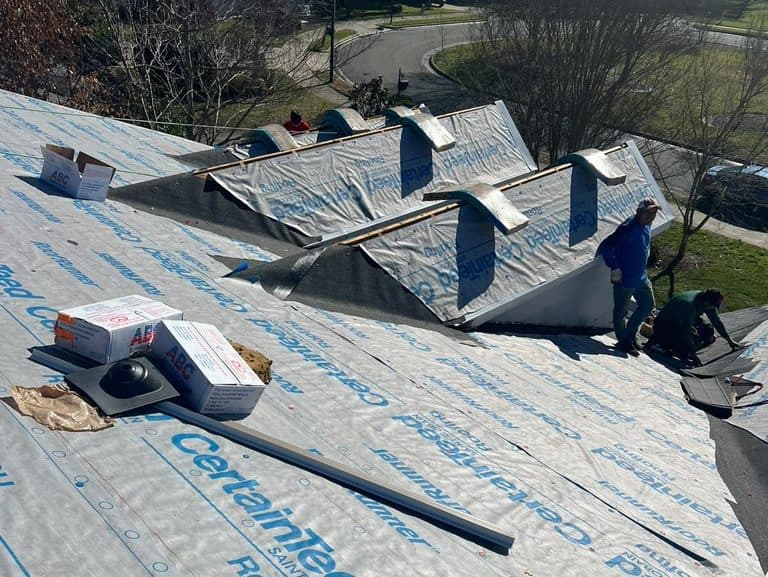
Understanding what a professional roof replacement involves helps Holly Springs homeowners evaluate contractors and estimates before any work begins.
The Pre-Replacement Inspection
A legitimate replacement starts with a thorough inspection of the existing roof and attic. The inspector should assess shingle condition across all sections, check the decking for soft spots and water damage, evaluate attic ventilation, and document all flashing locations. The findings from this inspection should produce a written scope of work that forms the basis of the estimate.
Tear-Off and Decking Evaluation
A full replacement involves removing the existing roofing materials down to the decking. This tear-off is what allows the crew to inspect and repair the decking before new materials go on. Any damaged decking boards should be replaced as part of the scope, and the estimate should address how decking repair is handled and priced.
Complete System Installation
A quality replacement installs a complete roofing system, not just new shingles. That includes ice and water shield at the eaves, valleys, and penetrations; synthetic underlayment across the full roof surface; starter strips at the eaves and rakes; new flashing at all penetrations and transitions; quality shingles installed to manufacturer specifications; and ridge cap and ridge ventilation at the peak.
Warranty Documentation
Before the crew leaves, you should have written documentation of both the manufacturer product warranty on the shingles and the contractor’s workmanship warranty. A 5-year workmanship warranty is a reasonable baseline from a quality Holly Springs contractor; some certified contractors offer longer coverage tied to manufacturer certification programs.
Making the Right Call for Your Holly Springs Home
When to replace a roof in Holly Springs, NC ultimately comes down to a combination of age, condition, and climate context. A roof that is 20-plus years old, showing multiple signs of advanced wear, and heading into another Holly Springs storm season without a professional evaluation is a roof that is more likely to force the replacement decision than let you make it on your own terms.
At Barkley-Jensen Roofing and Restoration, we help Holly Springs homeowners make that call with a thorough inspection, honest findings, and a clear explanation of whether repair or replacement is the right path. We are GAF Certified, licensed, and insured in North Carolina, and we back every replacement with a 5-year workmanship warranty. If your Holly Springs roof is approaching or past its expected lifespan, or if you have noticed any of the signs covered in this guide, contact us today for a free inspection and a straight assessment of where things stand.